
 Trade W
The MT5 micro account is a forex brokerage micro account on the MetaTrader 5 platform that allows trading in micro lots 1,000 units, or 0.01 lots with a relatively low minimum deposit, which minimizes the risk per trade and thus provides an opportunity for beginner traders and testers who only have a small amount of capital to trade live strategies. However, it is worth pointing out one structural element that most broker comparison pages do not mention: while some brokers offer a dedicated micro account product category, others allow 0.01 lot trading directly within a standard account. In both cases, this effectively serves the need for small-position trading on MT5. Understanding what lot sizes and micro lots actually mean before choosing a broker will help you avoid selecting the wrong account structure. Once this is understood, the relationship between leverage and margin interact with small balances, since the account name is less important than whether the platform allows 0.01 lot entries and whether the broker holding your funds is properly regulated.
In this guide, you will be able to examine regulated MT5 micro account brokers against real, verifiable metrics such as minimum deposits, spreads, regulatory tier, and platform features, and see how they allow you to start small and trade more safely. You can skip to the comparison table or continue reading for the full breakdown.
General risk warning: Trading forex and CFDs on leverage carries a significant risk of losing money. Most retail accounts incur losses; research suggests that approximately 70 to 75 percent of retail accounts lose money after netting their positions.
Quick Comparison: Best MT5 Micro Account Brokers (June 2026)
Ranked by regulation tier, minimum deposit, MT5 micro-lot support, and total trading cost. Last reviewed June 2026.
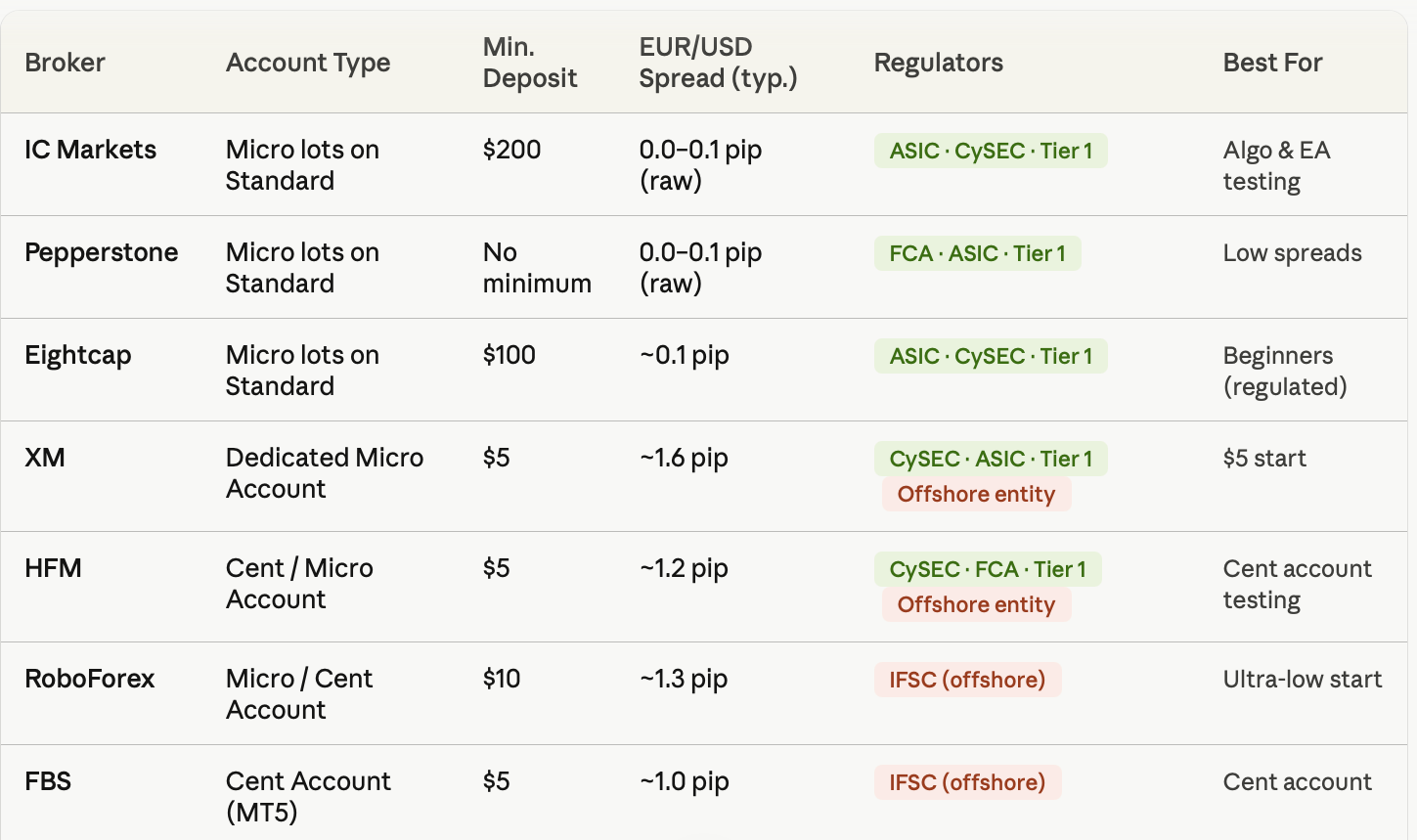
It is much more important to look at the spread column and the minimum deposit column together than to look at either one by itself. A $5 entry with a 1.6 pip spread will ultimately cost you more per trade over time than a $200 entry with a 0.0 pip raw spread. A review of the broker profiles below will help clarify this, and the safety section will help you understand the difference between Tier 1 regulated and offshore account structures in easy-to-understand language.
Want to practice micro-lot trading without any financial risk and test the full platform before committing a single dollar.
Top MT5 Micro Account Brokers: In-Depth Profiles
IC Markets: Best for Algorithmic Trading via Micro Lots
IC Markets doesn't offer a product labelled Micro Account, but its Standard and Raw Spread accounts support 0.01 lot execution on MT5, with regulation from ASIC and CySEC (Europe) under Tier-1 frameworks, meaning client funds are segregated and negative balance protection applies to retail clients in covered regions. Typical EUR/USD spreads on the Raw account sit at 0.0–0.1 pips plus a $3.50 per-side commission, making it one of the lowest all-in cost structures available. The $200 minimum deposit is higher than offshore alternatives, but it buys significantly better execution quality, full EA and Strategy Tester support on MT5, and reliable fund security. IC Markets suits EA developers and systematic traders who want to run live tests with minimal capital at risk. Pros: Institutional-grade raw spreads, full MT5 EA and copy trading support, strong Tier-1 regulation. Watch-out: $200 entry barrier is too high for absolute beginners looking to start with $10–$50.
Pepperstone: Best for Low Spreads with No Minimum Deposit
Pepperstone is regulated by FCA (UK) and ASIC (Australia), has no minimum deposit required, and allows clients to trade as low as 0.01 lots directly on its MT5 Standard and Razor accounts. Raw spreads (0.0 pips) on the Razor account and commission per trade rather than a spread fee on the standard account mean traders can expect spreads to average about 1.0 pip, with only commissions adding an additional fee. All features of MT5, including Expert Advisors (EAs), Strategy Tester, and Copy Trading, work regardless of account balance. Additionally, 72.9% of retail investor accounts who trade CFDs through Pepperstone typically lose money on these trades, based on information provided by the broker. Pros of trading with Pepperstone include no minimum deposit, compliance with FCA and ASIC regulators, and access to raw spread accounts. However, it is very important for beginner traders to consider the commission on the Razor account when evaluating trade costs against the headline spreads provided.
Eightcap: Best for Regulated Beginners Starting with $100
Eightcap, a broker regulated by both ASIC and CySEC, offers 0.01 micro-lot execution on MT5 when you start with as little as one hundred dollars. For the typical EUR/USD spread on its Raw account (with commission), you can expect a spread of around 0.1 pip, while if you use its Standard account (without commission) it will be around 1 pip. This makes it a good choice for all those looking for tier-one regulatory protection without needing to put up two hundred dollars to start trading. You will have full functionality of MT5, including EAs, mobile trading, and different types of assets, regardless of your account type. Pros: Tier one regulated; entry-level access at one hundred dollars; MT5 works cleanly with Eightcap’s systems. Watch-outs: Not the lowest priced broker for high-frequency trading; while there are no commissions on the Raw account, the commission for every trade will quickly add up at large volumes.
XM: Best for a Dedicated $5 Micro Account on MT5
XM has established a distinct category of Micro Accounts, each available on both the MT4 and MT5 trading platforms, which are accessible with a minimum deposit of only $5, making them one of the most affordable entry points into forex trading currently available. Some of XM’s regulated entities include both ASIC and CySEC, which are designated as Tier-1 regulators; however, the $5 Micro Account is subject to being managed through an entity that is not subject to Tier-1 regulation, which means that leverage can be as high as 1:1,000. The average spreads on the Micro Account for EUR/USD are approximately 1.6 pips, and no commissions are charged. This account type allows absolute beginners to practice trading with real money and learn how to execute their trades. Pros: It has a true Micro account designation, $5 to start, MT5 is available, and it is regulated via CySEC and ASIC at Tier 1 for other entities. Caveat: This account is regulated via an offshore entity; consequently, many of the retail trader protection schemes that can be utilized on standard retail accounts, such as the ICF, cannot be applied to this account offering.
HFM (HotForex): Best for Cent Account Testing
HFM has two different types of accounts available through the MT5 platform, both of which are regulated by CySEC and the FCA. One of those accounts, the Cent Account, allows trades to be executed in increments of one hundred units with balances displayed in cents, significantly decreasing the financial exposure of the account holder. Like XM, this data is related to an initial deposit of $5 made through non-regulated offshore entities rather than through Tier-1 regulated companies. The liquidity in EUR/USD is typically 1.2 pips. This type of account is appropriate for individuals who desire to maintain as little live exposure as possible while trading under real market conditions. Pros: Ability to hold Cent and Micro Accounts, $5 initial deposit, recognizable regulatory agencies. Issues: Trading through non-regulated offshore entities will likely provide less capital security than if the same trading were done with companies regulated by either CySEC or FCA.
Note: Low-value initial deposits on non-regulated account types may offer up to a maximum leverage of 1:1000, but have much lower levels of investor protection than Tier-1 regulated accounts. This is a more important consideration than the initial deposit amount.
How We Evaluated These Brokers
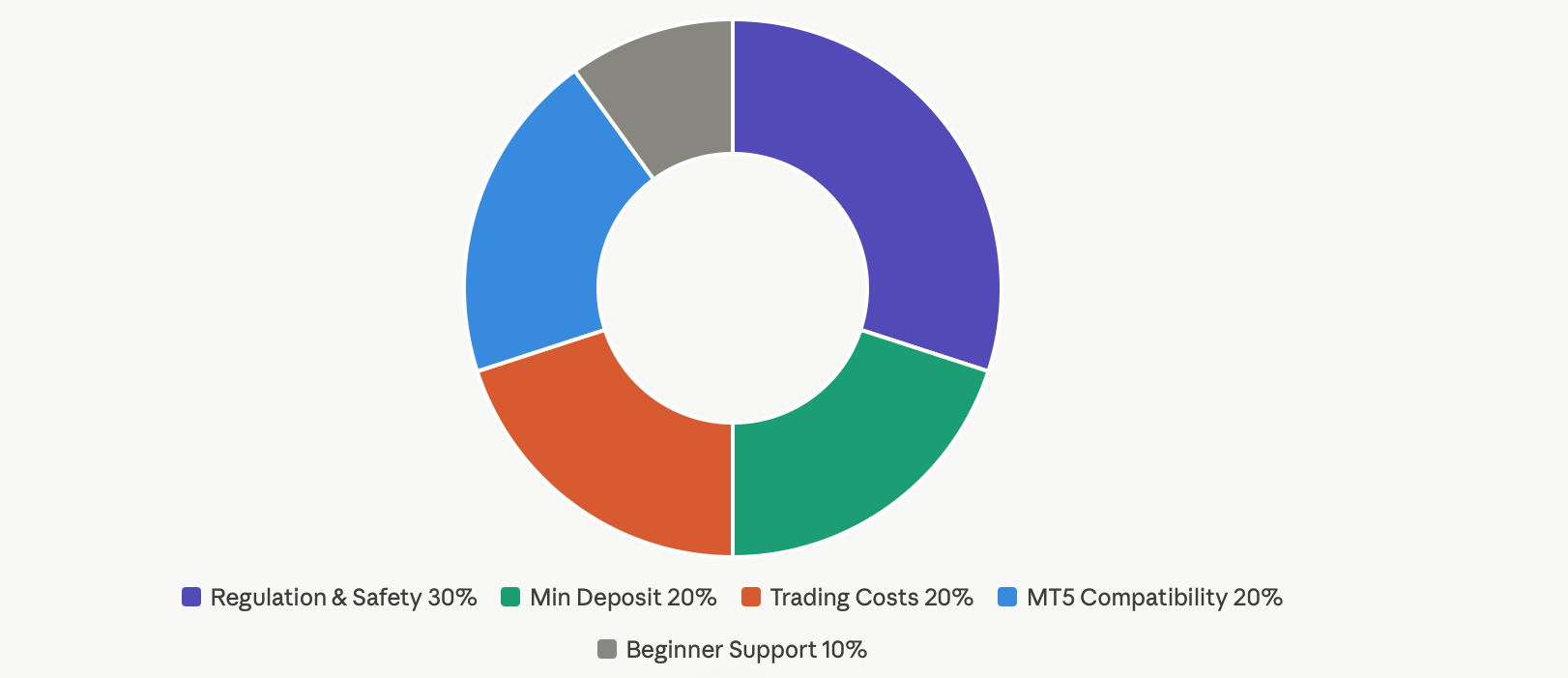
The ranking framework is based on the security and safeguarding of a trader’s funds and how they can open a small account with a broker, rather than how much commission they pay out or whether they are being marketed to. The ranking is based on five categories.
The first and largest category is regulations and safety, accounting for 30% of the total, and we validate that a trader’s broker is Tier-1 regulated, that they provide negative balance protection, and that they segregate client funds. The second category is minimum funding and accessibility, accounting for 20%, which allows us to establish whether a trader’s minimum deposit is realistic for a retail trader. The third category is trading costs, accounting for 20%, and involves tracking all-in trading costs, meaning the total cost of both spreads and commissions, not just the spread. The fourth category is MT5 compatibility, which ensures that all trading actions can be executed on the MT5 platform; specifically, that it supports 0.01 lot sizes, Expert Advisors (EAs), that the Strategy Tester builds EAs, and can be used for copy trading. The fifth category, accounting for 10% of the overall ranking, includes the quality of both demo accounts and educational resources for beginner traders.
All data used in the ranking of brokers in this report comes from the broker’s official specifications, regulatory registries such as FCA, ASIC, and CySEC, and actual live trading samples from traders. All data was collected as of June 2026 and will be reviewed by traders on a quarterly basis. Within the framework of this page, found here, Traderwill has established a documented relationship with each broker being compared. The relationship is solely based on documented broker specifications.
Rankings are for informational purposes only and are not an endorsement to open an account. Traders should contact the broker directly to obtain the most up-to-date terms available prior to opening an account.
What Is a Micro Account? Dedicated Account vs. Micro-Lot Execution
A Micro Account is a trade framework based on a minimum lot size of 0.01 (1,000 units), a low initial deposit, and lighter overall risk exposure per trade. On the MetaTrader 5 platform, 1 micro lot on EUR/USD has a value of approximately $0.10; this means that a 20-pip move against the position will cost you $2, not $20 and definitely not $200.
What you might not find on most comparison websites is this: a micro account could mean totally different things to different brokers. Basically, some firms, like XM or HFM, offer what can be called Micro Account products, with their own listings, application processes, and terms devoted solely to them. Other brokers, like IC Markets and Pepperstone, do not use such labeling, but they still allow you to execute a trade with a 0.01 lot size on their standard tier. The difference is minor when it comes to actual daily trading; what does matter is whether the MT5 platform permits a trader to assign a 0.01 lot size to an entry, not what it is called.
Micro accounts are ideal for safeguarding capital throughout the learning period, combined with live strategy testing, and they provide experience in market sentiment without exposing a trader to excessive capital risk. The only downside to this structural limitation is that the sums you will make will, for want of a better term, be paltry. Hence, they are training tools and not income instruments. Position sizing and risk management frameworks become even more paramount when the balance gets too small because there is not much of a buffer on margin.
A Micro Account simply makes the size of the risk per trade smaller. You are still bound to incur losses.
Account Types Compared: Micro vs. Cent vs. Mini vs. Standard
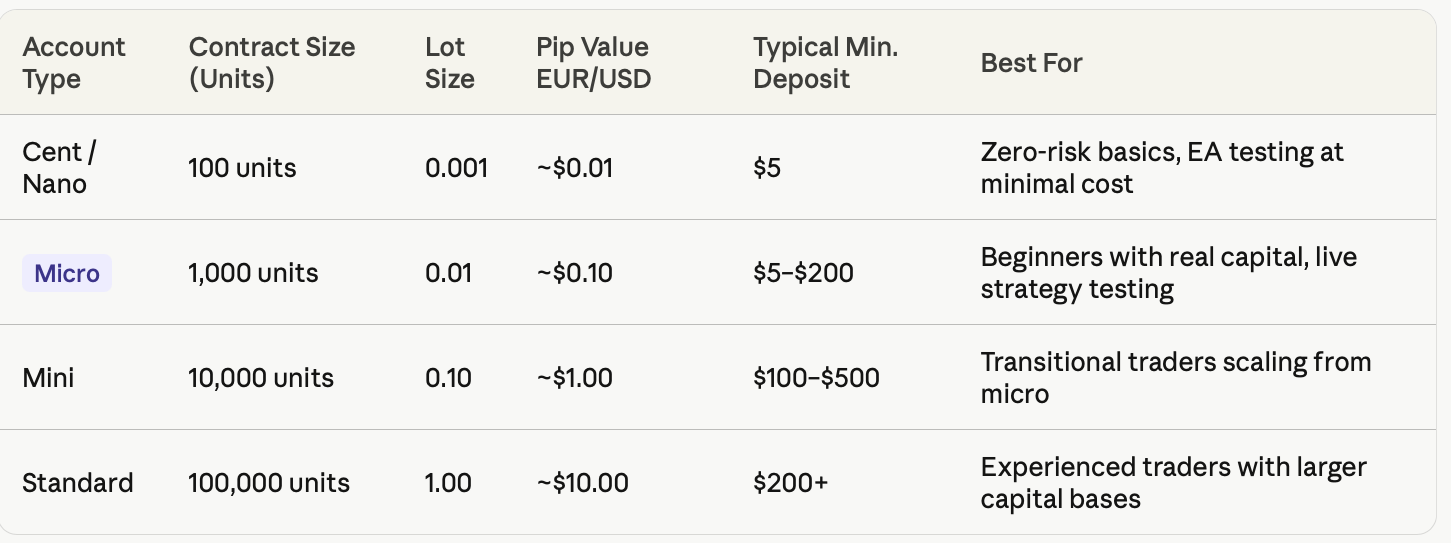
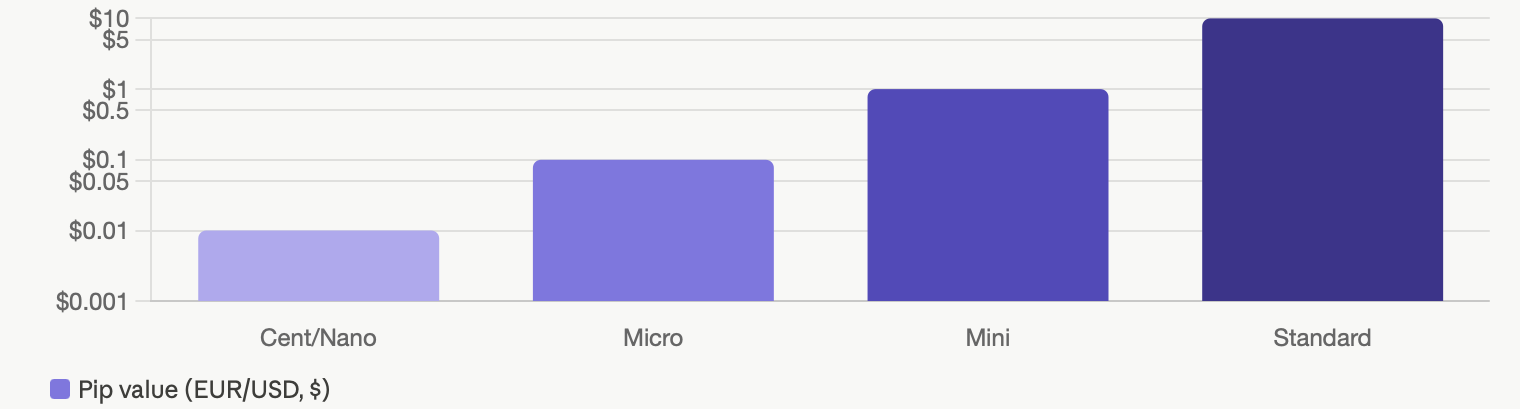
The mathematical relationship of the profit and loss scales between these tiers is very simple. Micro lots have a pip value worth 10 times that of a cent or nano lot, and a standard lot has a pip value worth 100 times that of a micro lot. For example, a 50-pip loss on a standard lot will cost you roughly $500, whereas the exact same trade performed using a micro lot would cost you $5.
The mechanics of a carry trade mechanics and interest rate differentials can be used to generate returns on larger accounts scale in relation to each incrementally larger account size. This is why micro accounts serve well as an environment for training but not as a primary source of income.
The larger the lot size, the larger the pip value and, therefore, the larger the potential loss, assuming the trade goes against you.
Does MT5 Support Micro Accounts? Platform Features for Small Accounts
On the MetaTrader 5 platform, microlot trading is possible using a minimum lot size of 0.01. However, you have to remember that MT5 is a product created by MetaQuotes and is simply the trading terminal from which you trade. The company does not define account minimums, account leverage, account types, or lot sizes.
Each broker controls the rules of its accounts, such as the minimum deposit required to open an account, the maximum leverage allowed, the types of accounts offered, and the minimum lot size that can be traded. For example, theoretically, if someone opened an account with $5 or $5,000,000, the MetaQuotes software would allow it; however, it is up to the broker to define these requirements.
For micro account traders specifically, there are several reasons to choose MT5 over alternative platforms. One of the key features of MT5 is its support for Expert Advisors (EAs), which allows traders to execute their strategies automatically, provided they set the parameters correctly. This gives a trader with limited risk exposure an opportunity to test a strategy by running it through an EA automatically against live market data. Traders also have access to a built-in Strategy Tester, which allows them to perform historical backtesting on their systems before using real funds.
In addition, MT5 includes a Copy Trading feature that allows new traders to mirror the strategies of experienced traders while maintaining full control over how much capital and what lot sizes they trade. The mobile app for both iOS and Android contains much of the functionality available in the MT5 desktop terminal. The mobile application allows traders to trade across four major market categories (forex, indices, commodities, and equities) with a single login, thus providing multi-asset trading capability through one account. Before using an EA with real money, you should fully understand how algorithmic and automated trading strategies actually work.
Automated trading strategies that are not fully tested can lose money very quickly. Always test an EA using the MT5 Strategy Tester and a demo account before deploying it with real capital.
How Much Can You Trade With a $100 Micro Account? Position Sizing in Practice
A $100 micro account trading EUR/USD at 0.01 lots produces a pip value of approximately $0.10. A standard 20-pip intraday move generates a $2.00 profit or loss, meaningful enough to feel real, small enough to survive a learning curve
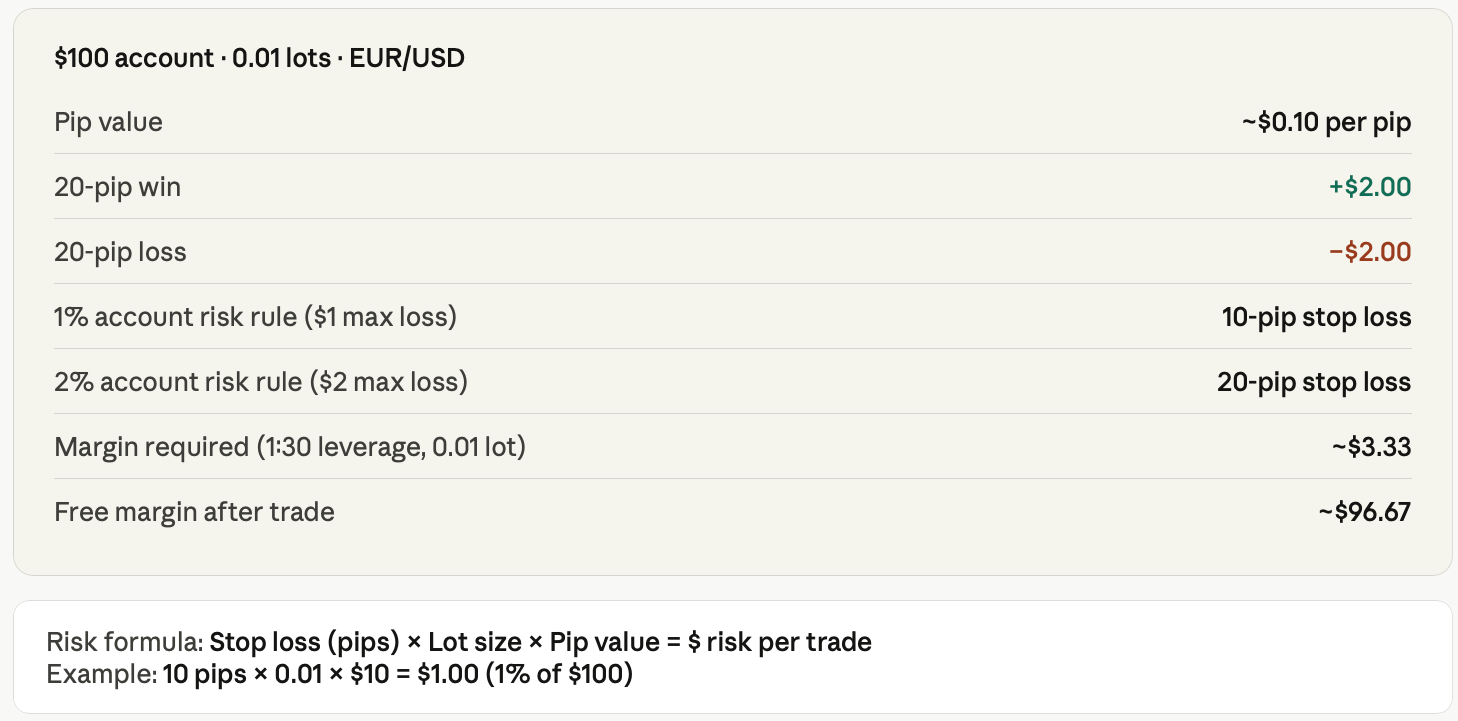
To determine the allowable amount to risk on one trade when using an initial capital risk limit of 1%-2% per trade on a $100 trading balance, each trade will have a maximum stop-loss risk of $1.00-$2.00, depending on your level of risk tolerance. If you intend to trade a lot size of 0.01 lots and use a predetermined risk tolerance of $1.00, then your stop loss will be a maximum of 10 pips, assuming a pip value of $0.10 on the EUR/USD pair in a scalping or intraday strategy. At a regulated leverage ratio of 1:30, the required margin to trade a 0.01-lot EUR/USD position will be approximately $3.33, which leaves you with $96.67 available as a margin buffer. This margin buffer can absorb normal price movements without causing a margin call, assuming you do not have multiple positions open at the same time. Before live trading commences, it is imperative to learn how various risk management frameworks apply to small accounts because they can make or break your trading by determining whether your micro account will remain profitable over the next six months or lose all of its funds within one week.
Trading beyond your acceptable risk tolerance, along with placing a series of trades without stop losses on a small account, will quickly reduce your trading balance to $0.00. Therefore, risk control, not profit targets, should be the foundation of your trading approach.
Is a Micro Account Safe? Regulated vs. Offshore Accounts Explained
For starters, micro accounts are an excellent option for novice traders because they enable them to take positions with less exposure while learning how markets operate in real time. However, micro accounts do not determine whether a trader's funds are safe, as this is governed by the regulator that oversees the broker and the custody of client funds.
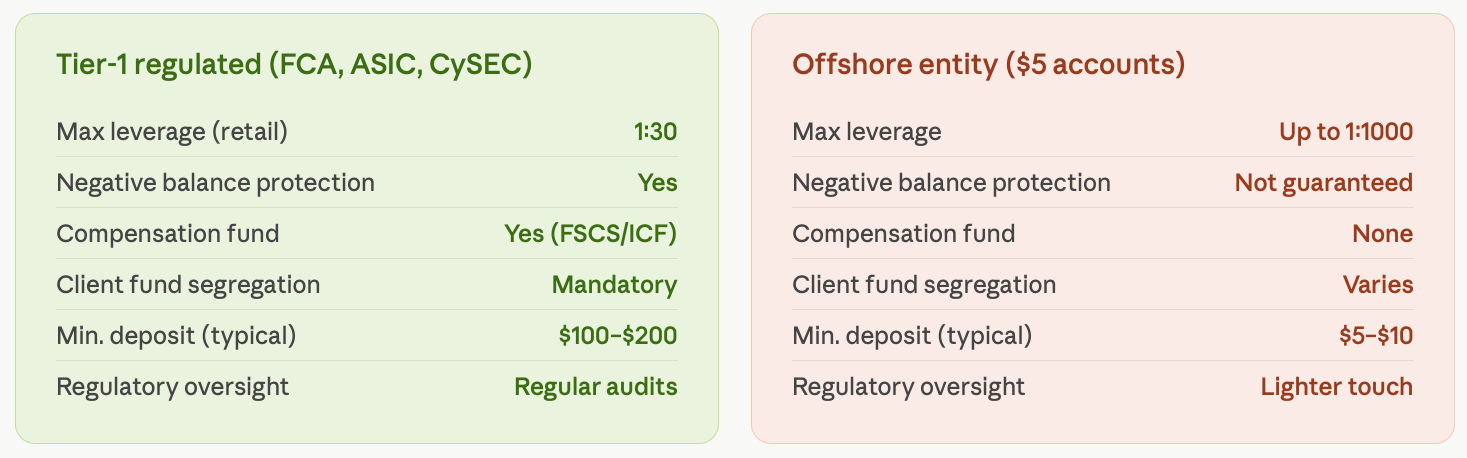
Brokers such as XM (Cyprus) and HFM (Australia) operate through recognized regulated affiliates and entities, where investors ultimately benefit from the protections afforded by Tier-1 regulatory frameworks through their respective CySEC (Cyprus Securities and Exchange Commission) or ASIC (Australian Securities and Investments Commission) licensed divisions. Unfortunately, a trader's account with a $5 minimum deposit micro account is generally not held under a Tier-1 regulated entity within either the XM or HFM group. Instead, such accounts are typically housed within one of the firms' offshore divisions. In other words, to determine the actual level of protection afforded to your account, you should consult the relevant regulator's registry rather than relying solely on the broker's brand name.
The correct progression for establishing yourself as a trader is to start with a demo account, then open a small regulated, non-highly leveraged micro or standard account, always use stop-loss orders on every trade, and only trade with funds that you can genuinely afford to lose. Understanding how global macroeconomic events and fiscal policy shifts affect trading environments can affect the trading environment is also helpful in understanding why leverage limits are imposed to protect investors from potentially devastating losses.
While a micro account limits the size of your position, it does not limit your exposure to the market. For example, from the perspective of a novice trader, using a very inexpensive, highly leveraged offshore account could be one of the most dangerous ways to start trading, even though such accounts typically offer a very low cost of entry.
How to Open a Micro Account on MT5: Step-by-Step
Step 1: Choose a regulated broker - Select a Tier-1 regulated broker that supports 0.01-lot execution on MT5, using the comparison table above as your starting point. If you want to start with $100 or even less in a properly regulated environment, Eightcap or Pepperstone are among the strongest candidates.
Step 2: Register and complete KYC - Create an account online and submit KYC (Know Your Customer) documents, usually a government-issued photo ID and proof of address. Most brokers complete this process within 24 hours.
Step 3: Select your account type and platform - If the broker offers a micro account, choose that; if not, choose the standard account, provided the broker supports 0.01-lot execution at that tier. Then select MT5 as your platform rather than MT4, as it provides faster execution, more timeframes, and a more future-proof trading environment.
Step 4: Download MT5 and log in - Download and install MetaTrader 5 on your desktop or mobile device using your broker's server credentials. The platform is free. Spend some time in the demo environment practicing order entry, stop-loss placement, and terminal navigation before moving to live trading.
Step 5: Fund and execute your first trade - Deposit an amount within your risk limits. Starting with $50-$100 generally makes more sense than starting with $5 because it provides a little more room to manage trades effectively. Open your first 0.01-lot trade on a major currency pair such as EUR/USD and observe how pip movements translate into actual dollar gains and losses.
Do not fund a live account with money you cannot afford to lose. Practice on the MT5 demo platform before live trading, as it is free and provides an excellent opportunity to learn the platform and trading mechanics.
Ready to start small with a regulated MT5 account? Open your account and begin with 0.01 lots.
Common Mistakes to Avoid With a Micro Account
Inadequate investor protection is often associated with the lowest-deposit accounts. Make sure to verify the specific regulated entity by checking the official regulator's registry before making any deposit.
Using leverage of 1:1000 as a risk multiplier can rapidly lead to account liquidation. An adverse move of just 0.1% against a fully margined position at 1:1000 leverage can liquidate a client's account. Always keep leverage low and align it with your stop-loss placement, not your profit objectives.
Filtering out brokers that do not offer a dedicated micro account could cause you to overlook excellent brokers such as IC Markets and Pepperstone. These firms are heavily regulated and offer some of the lowest spreads available, even though they label their accounts as Standard. Importantly, these accounts still allow trading with 0.01-lot positions.
Not using a demo account or terminal can lead to losses caused by order-entry mistakes rather than incorrect market analysis. The MT5 demo account is free and provides the same functionality as the live trading terminal.
Creating positions that are disproportionate to the size of your account balance can lead to margin calls during normal market volatility. Adhering to a maximum risk per trade of 1%-2% of your total account balance is one of the best ways to protect your capital while attempting to grow a small account.
When evaluating spreads, clients should also account for commissions, overnight swap fees, and deposit or withdrawal charges when calculating the total cost of trading with a specific broker.
Failing to check withdrawal terms before making a deposit can ultimately lead to disappointment due to processing delays or unexpected fees.
Over-leveraging a small account is the quickest way to eliminate it. A $5 account is generally far more vulnerable to being wiped out than a $200 account.
Frequently Asked Questions
What is a micro account in forex trading?
An MT5 micro account allows trading in micro lots — 1,000 units, or 0.01 lots — with a low minimum deposit. Each pip change on EUR/USD equals approximately $0.10, minimising absolute trade risk. It's ideal for beginners and live strategy testing.
Which brokers offer MT5 micro accounts?
XM, HFM, and FXGT offer dedicated Micro or Cent account categories on MT5. IC Markets, Pepperstone, and Eightcap support native 0.01 lot execution inside standard account structures — all on MT5.
What is the minimum deposit for an MT5 micro account?
Deposits range from $5 to $200 depending on the broker. $5 entry barriers are typically offshore entities; Tier-1 regulated brokers like Eightcap and IC Markets require $100–$200 but provide significantly better capital protection.
Is a micro account good for beginners?
Yes. Micro accounts restrict position size and absolute currency exposure while providing authentic live MT5 execution, making them a safer path to practical market experience than starting on standard lots.
Can I use MT5 with a micro account?
Yes. MetaTrader 5 natively manages 0.01 lot entries. Brokers control account types and minimum deposits; MT5 itself handles micro-lot execution smoothly regardless of account balance.
What's the difference between a micro account and a cent account?
A micro account transacts in 1,000-unit blocks ($0.10 per pip). A cent account processes 100-unit structures and displays balances in cents ($0.01 per pip), offering the smallest exposure available for absolute beginners.
What leverage do micro accounts offer?
Tier-1 regulated jurisdictions cap retail leverage at 1:30 for major pairs. Offshore broker divisions can offer up to 1:1000, which increases risk substantially and is not appropriate for beginners.
Is MT5 better than MT4 for a micro account?
Yes. MT5 offers faster execution, more chart timeframes, built-in economic indicators, and superior EA functionality. Both handle micro lots, but MT5 is a more capable and future-proof environment.
Can I open an MT5 micro account with $10?
Yes, several brokers accept $10. A $10 balance provides minimal margin buffer at any lot size, making it highly vulnerable to margin calls. Starting with $50–$100 offers meaningfully better account longevity.
Can I make money with a micro account?
Yes, but absolute profits are small because position sizes are small. Micro accounts are best used as educational and strategy validation tools to build consistency, not as vehicles for rapid capital growth.
Conclusion: Start Small, Start Right
Ultimately, there are just three aspects that determine whether you will succeed with a micro account: Verify that your broker is regulated by a credible governing authority. Do not just look at the brand; verify the specific regulated entity. Ensure you are using the correct platform and tools for 0.01-lot execution, such as an MT5 setup that aligns with your trading style (e.g., Expert Advisors, signals, etc.). Before funding a live account, establish a clear set of risk management guidelines, as insufficient risk management will cause your micro balance to erode quickly.
Additionally, it is essential to be able to read financial statements and evaluate market fundamentals alongside your technical trading approach. Understanding both aspects of the market is one of the key differences between traders who are able to maintain long-term success and those who are not.
Try Tradewill's MT5 platform on a free demo account first, practice 0.01-lot execution risk-free, then open a regulated live account when you're ready to start for real.
Disclaimer: The content of the blog does not represent any position of Trade W, does not serve as any trading-related decision advice, and does not endorse any third-party.