

 Trade W
Why Gold Still Matters in 2026: Understanding the World's Most Trusted Investment Asset
Over thousands of years, gold has been known for both its literal and financial weight, and that reputation persists even with markets becoming more complicated than they used to be; investors turn to gold whenever a currency is shaky, their savings are losing value due to inflation, or there is uncertainty about equities due to heightened geopolitical tensions. If you have been reading about currency markets, such as forex bear markets or trying to comprehend how quantitative easing will affect currency value, it should be obvious that gold has been mentioned in the future numerous times as an asset that people turn towards when confidence in paper currency declines.
Unlike stocks or bonds, gold does not depend upon the earnings of companies or promises by governments; it is a physical commodity with limited availability, and that scarcity is part of the reason why, over the last ten years, central banks around the world have been acquiring and increasing their gold reserves. In addition, individual investors have joined the trend of acquiring gold in physical form (to some extent) through gold coins stored at home in a safe, or purchasing shares of exchange-traded funds (ETFs) that trade in the stock market, or creating a contract for difference (CFD) position without ever taking possession of gold or money through means of prudence, timing, and location.
The period from owning a tangible amount of gold to being able to acquire gold through electronic means has opened the door to thousands of potential investors rather than a few hundred. Today, one can purchase an ETF for gold through their brokerage account on their lunch break or create a CFD position on XAU/USD within a few minutes over coffee. Due to the aforementioned, the question, what is the appropriate method for going about purchasing an investment in gold, continues to arise from many people, and the only way for me to adequately respond to this question is that it will depend on the specific individual.
Gold does not represent only one type of investment product; gold represents an entire asset class that can be implemented in many different ways. Each implementation has varying degrees of expense, liquidity, or risk. This article provides a breakdown of all the different options when investing in gold so that the reader can identify the best option for them rather than just making assumptions on their own.
Why Invest in Gold? 4 Powerful Reasons Investors Continue Buying Gold
Gold as an Inflation Hedge
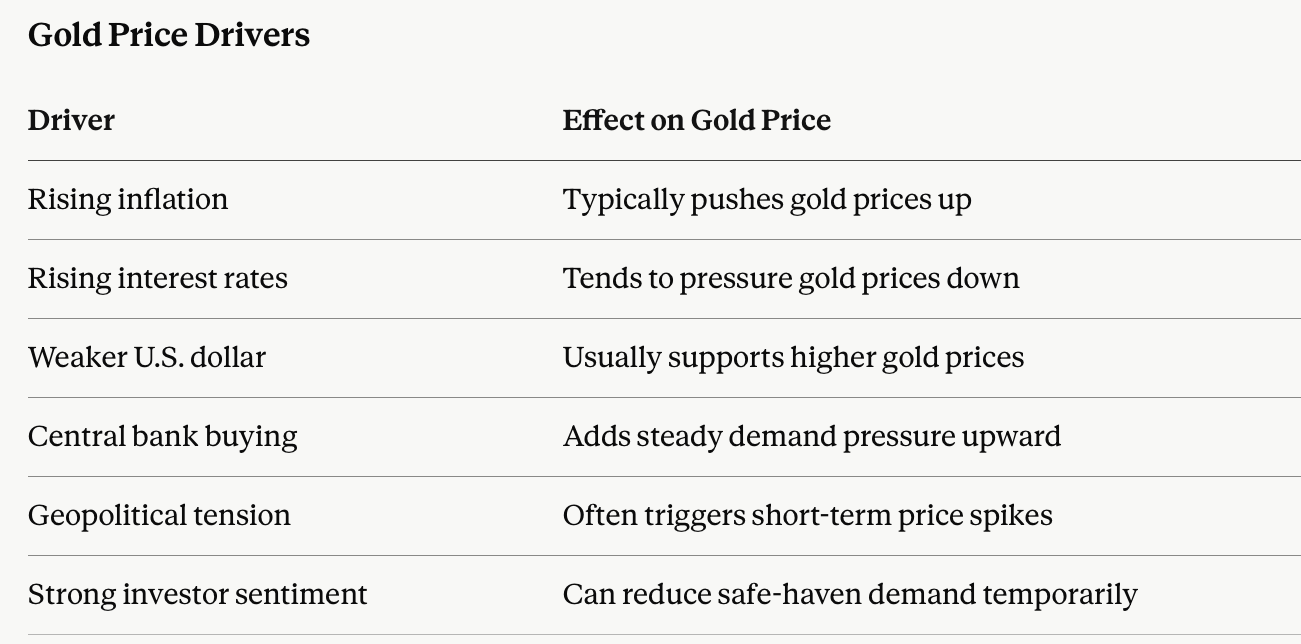
An economy can experience an erosion of the purchasing power of the currency in use due to rising prices. Historical evidence shows that, in times of uncertainty and inflation, gold often provides an alternative to cash as it tends to retain its value better than most other asset classes. In the past year, rising prices along with inflation have caused a decline in consumer confidence, leading many people to look for alternative places to invest their cash where it does not depreciate at the same rate as traditional bank accounts. The relationship isn't perfect or guaranteed every single year, but over multi-decade stretches, gold has done a reasonable job of preserving real value when inflation hedge strategies become a priority for long-term investors.
Gold as a Safe-Haven Asset
Trustworthy assets are likely to attract investors looking for safety during times of economic instability. The 2008 and 2020 crises both resulted in large increases in gold sales as the stock market declined dramatically. This investor behaviour of moving towards safe asset classes like gold is a key factor for gold’s presence within numerous institutional allocations when compared to more volatile investment options, like small-cap stocks.
Gold for Portfolio Diversification
Gold's price movements are not strongly correlated with those of stocks or bonds. This lack of correlation can help you lower your overall portfolio risk by reducing the risk taken on when adding equities. Investing only in equities can lead to wide swings in portfolio value when equities are under pressure, but when you add a gold holding to your portfolio that does not always move in the same direction as stock markets, you reduce some of that volatility. Just as you try to understand what risk is being taken before you put capital into stocks of companies by examining the company's financial statements, investing in or buying gold provides you with a different type of risk exposure entirely.
Gold and the U.S. Dollar Relationship
Gold and U.S. currency have a long-standing inverse correlation; as dollar values decline, the price of gold rises and vice versa. The Federal Reserve's decisions regarding interest rates can greatly influence this correlation, as they increase investor interest in yield-producing assets compared to non-yield-producing assets such as gold. Traders who follow FOMC minutes for insight into market trends often use them to forecast how these same trends may affect gold prices in the coming weeks.
How to Invest in Gold: 5 Popular Gold Investment Options Explained
Physical Gold
Purchasing gold in the form of coins or bars has been around for centuries; both provide the buyer with a physical object that can be held, stored, and eventually passed on to another person. However, it can also present problems in the way of finding a secure place to store it (home safe vs paid vault), purchasing insurance (which is yet another ongoing cost), and selling a physical item can be a little more difficult than just pressing a button to sell. The liquidity of a physical investment like gold is less than that of digital alternatives due to the higher premiums associated with purchasing from dealers.
Gold ETFs
Gold-backed Exchange-traded funds allow individuals to gain access to gold's value without owning the physical asset itself. You can trade shares of these funds as you would with any other security, and they take care of all the physical custody and security of your investment. As a result, ETFs are a very popular way for new investors to get into the market since passive investing appeals to those looking to gain exposure to an investment without having to manage it actively.
Gold Mining Stocks
You are able to invest in gold through purchasing stakes in gold mining companies as opposed to purchasing gold directly, as individual companies have operational risk in addition to the risk of the price of gold alone. Mining companies have their own costs of production and management decisions to make, and are also affected by the political climate that affects where they operate. If you are looking to invest in gold from a growth perspective, consider that there are some stocks of mining companies that pay dividends and therefore provide an additional source of income over just the appreciation of gold itself or gold ETFs. When it comes to owning stocks in gold mining companies, it is also very important that you have a good understanding of the company's economic moat, as there are many mining companies that will not survive through a downturn in gold prices.
Gold CFDs
Traders have the opportunity to invest in gold without having to acquire actual bars or coins by using contracts for difference to speculate on price movements using an XAU/USD exchange rate; these contracts allow leverage and provide investors with the ability to take long or short positions. However, with this type of trading, there is also a considerable amount of risk involved. The most significant consideration includes understanding why initial margin matters, which will help you determine how large an investment you should make, as position requirements can change based on the performance of other markets.
Gold Futures
A futures contract is a contract to purchase or sell gold at a future date and price. Many institutional traders and gold producers use futures contracts to offset price risk. Because of the size of the margin and the amount of the contract, futures are not as accessible for individual retail investors. However, futures contracts can be one of the most liquid methods of trading gold in large volumes.
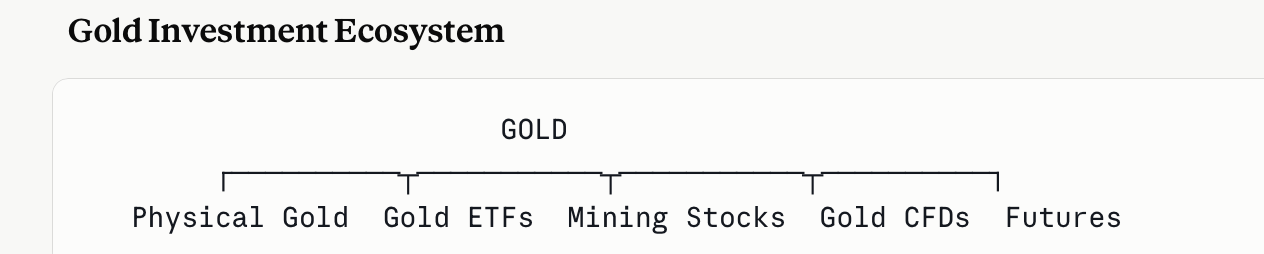
None of these five products is superior to the others; they ultimately meet the needs of different types of investors. How you select the appropriate product will depend on your investment timeframe, risk tolerance, and desired level of involvement.
Gold ETF vs Physical Gold vs CFDs: Comparing the Pros and Cons of Every Gold Investment Method
Comparing these options side by side makes the tradeoffs much clearer than reading about them one at a time.
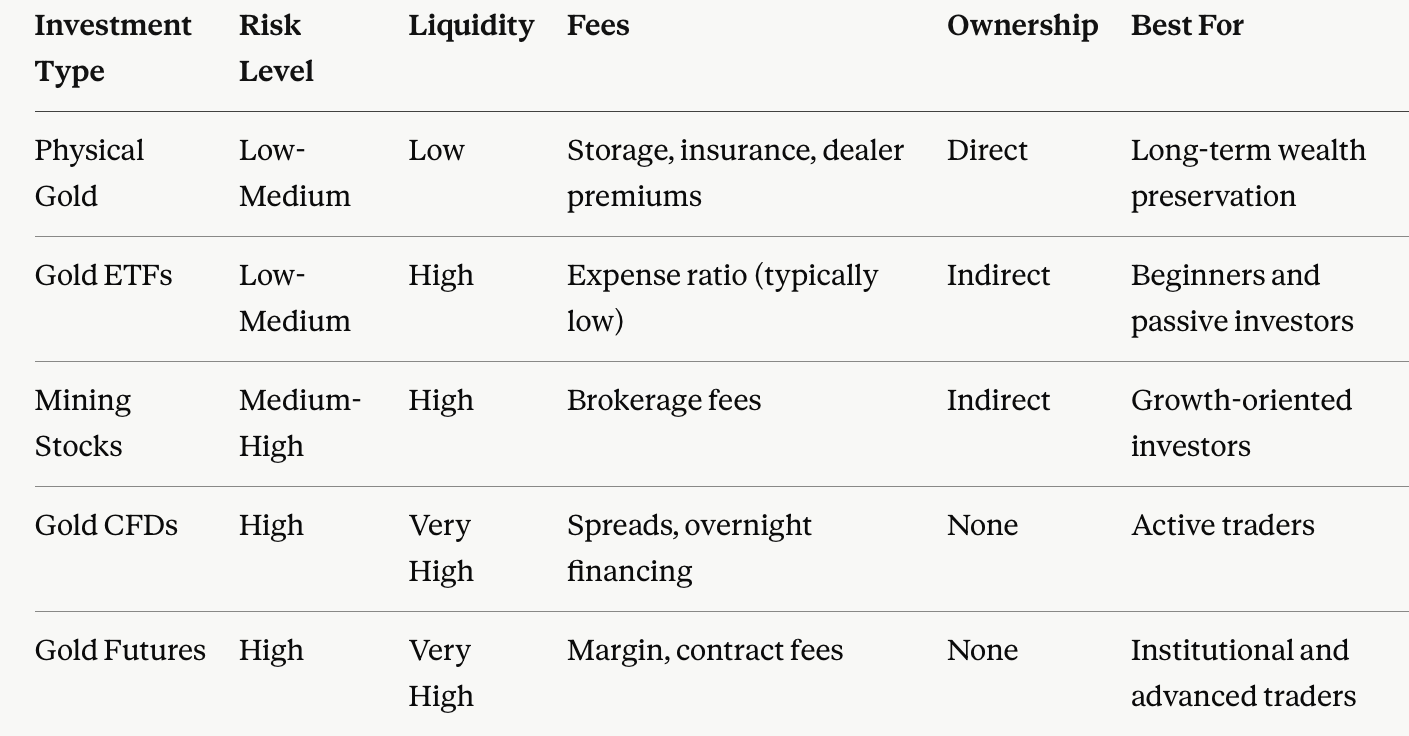
$10,000 can be divided among several different types of investments. People who want to directly invest in gold have the added burden of having to store and insure their gold. When making a direct investment in physical gold, an investor must also be willing to accept that it may take longer to turn their gold into cash compared to other forms of investment. An ETF is similar to a stock in that it is actively traded on a stock exchange and only requires an annual fee for the money invested in that fund. Someone who purchases an ETF can sell out of the ETF at any time during normal business hours. A CFD trader utilises margin by depositing a small percentage of the $10,000 to create a much larger notional position. As such, if a CFD trader is successful in their trading strategy, they are exposed to much greater profit or loss than if they had invested the entire $10,000 in a CFD. All three methods of investing have their positives and negatives depending on your overall objective for your investment. There is no "right" or "wrong" way to invest in gold; the optimal approach depends on how much money you want to invest, how much you are willing to risk, and how much time you want to spend managing your investment.
What Is the Best Way to Invest in Gold? Choosing the Right Strategy for Your Goals
Best Gold Investment for Beginners: Gold ETFs
ETFs strip away the complications of storage and insurance while still giving you direct exposure to the gold price movement. For someone just starting out, this combination of simplicity and liquidity is hard to beat.
Best Gold Investment for Long-Term Investors: Physical Gold and Gold ETFs
A blend of both gives long-term holders the tangible security of physical bullion alongside the convenience and liquidity of ETF shares, letting them rebalance more easily when needed.
Best Gold Investment for Active Traders: Gold CFDs
Traders looking to capitalise on short-term price swings benefit from the leverage and flexibility CFDs provide, including the ability to go short when gold prices are falling, not just long when they're rising.
Best Gold Investment for Wealth Preservation: Physical Gold
For investors whose primary concern is protecting capital across decades rather than generating active returns, direct ownership of physical gold remains the most straightforward choice.
Best Gold Investment for Growth-Oriented Investors: Gold Mining Stocks
Investors comfortable with additional operational risk can pursue higher upside through mining stocks, particularly companies with strong economic moats and disciplined cost management.
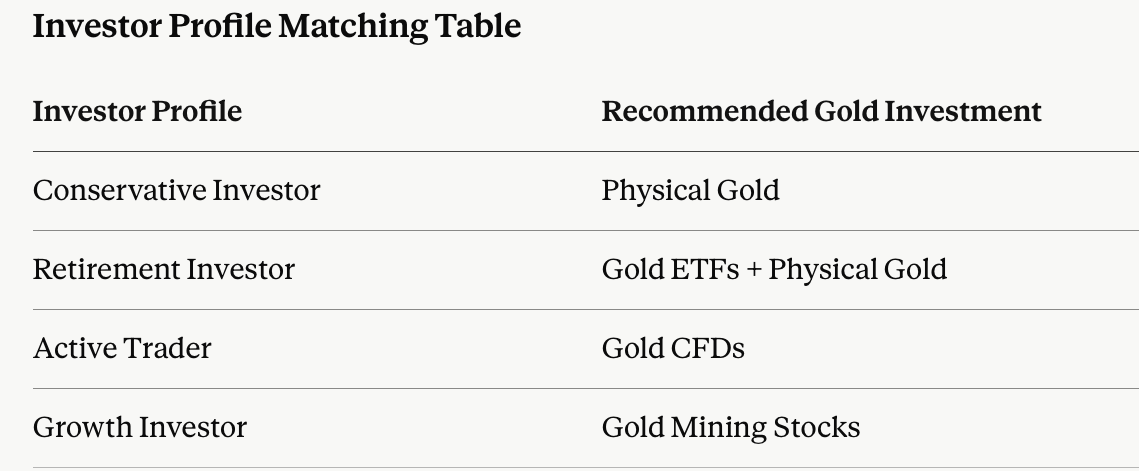
There is no single correct answer to what is the best way to invest in gold. The right strategy is the one that lines up with your goals, your risk tolerance, and how much time you're willing to put into managing the position.
Gold Investing vs Gold Trading: Which Approach Is Right for You?
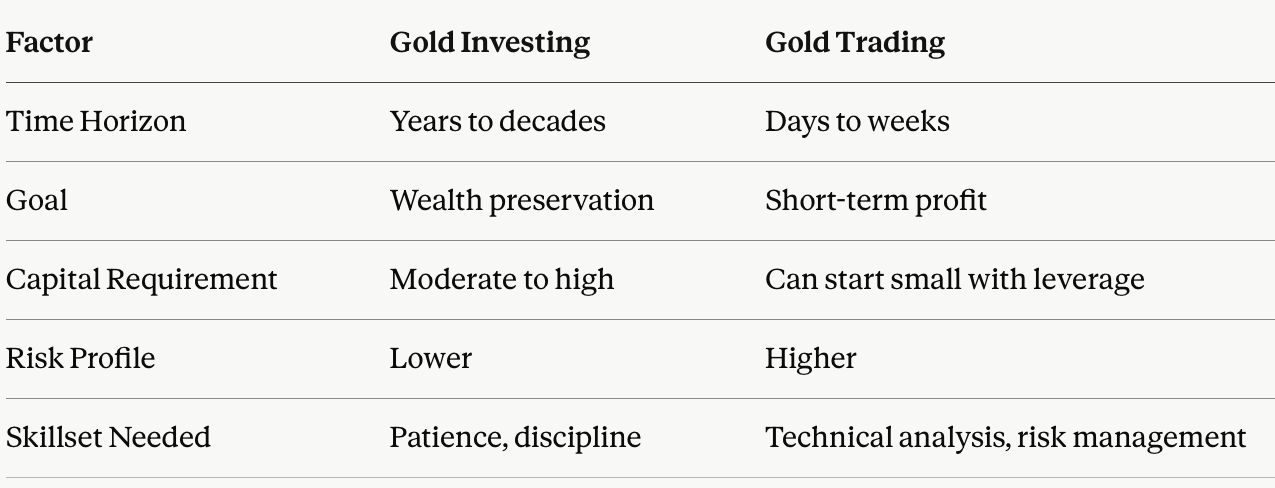
Despite both activities involving the same underlying asset, investing in gold and trading gold are completely different activities. When investors purchase gold, they typically intend to retain ownership of the asset for the long term, with the intention of either preserving their wealth and/or diversifying their overall portfolios. Any investor who purchases gold ETFs and holds them for 5 years does not care about daily price movements; they are thinking in years, not hours, and using gold as an anchor for their overall portfolio.
Gold trading, on the other hand, is primarily for short-term speculative purposes and involves technical analysis and precise timing to enter and exit trades. A CFD trader observing XAU/USD on a 5-minute chart will have an entirely different mindset than an investor who purchases gold with the expectation that they will sell it 5 years later; they are looking for opportunities to enter and exit trades within a day or two, as opposed to 5 years. Gold trading, therefore, closely resembles algorithmic trading strategies rather than traditional buy-and-hold investing strategies.
6 Costly Gold Investing Mistakes That Can Hurt Your Returns
Common Mistakes in Investing in Gold
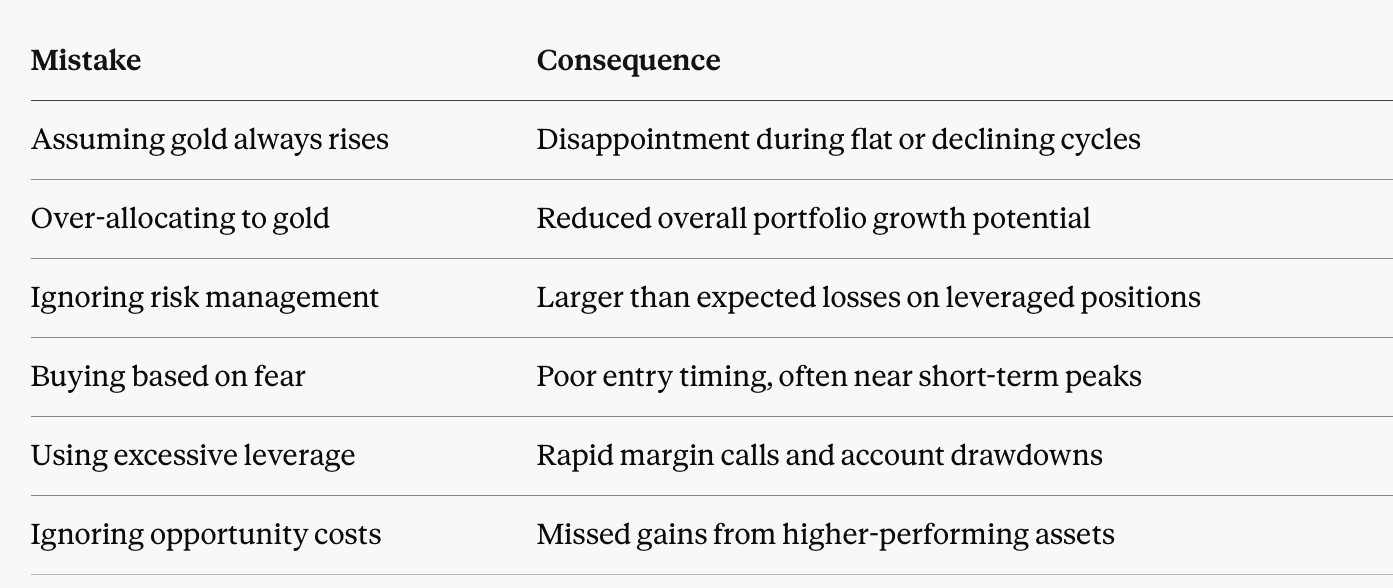
Gold is an investment that is not without its share of mistakes. Below are six common mistakes to avoid when investing in gold.
Mistake 1: Believing that the price of gold will always increase
Gold has seen many years where its price was flat or declining. When you believe gold's price will always go up, you set yourself up for disappointment if the price of gold declines.
Mistake 2: Putting too much money into gold
Gold is a good portfolio diversification tool; however, it should not be your only investment. If you have a large amount of money in one asset class (including gold), it increases your overall investment risk.
Mistake 3: Not having a risk management plan
This can be especially important with leveraged products such as CFDs and futures. Price fluctuations can happen overnight and may eliminate your position faster than with physical gold or gold ETFs.
Mistake 4: Panic buying during times of crisis
Panic buying during a time of crisis typically means you have bought the asset when the majority of other investors are also purchasing it. Thus, very often investors will buy after the price has already increased to a new high.
Mistake 5: Using too much leverage when investing in gold
Large amounts of leverage can increase both your losses and your gains. Many new gold CFD traders forget how quickly their margin can be called.
Mistake 6: Not considering opportunity cost
The capital that you have tied up in gold is not being used to invest in other potentially higher-performing investment alternatives, such as blue-chip investments. You must carefully weigh the opportunity cost of not investing your money in a higher-performing asset class.
How to Start Investing in Gold: A Step-by-Step Guide for Beginners
Step 1: Establish an investment goal. Whether you're looking to preserve or increase wealth, diversify a portfolio, trade in the markets, or make a short-term profit (due to fluctuations in the value of gold), your answer will determine every future decision you make.
Step 2: Identify an appropriate method for gold investing. Look to the table on page 8 for a comparison between various gold investment methods to determine which method will help you achieve your goal. Some common methods include physical gold bullion, exchange-traded funds (ETFs), mining stocks, and contracts for difference (CFDs).
Step 3: Choose a trusted investment platform. A good platform will have clear fee structures, high liquidity, and offer compatible trading and investment products.
Step 4: Apply sound risk management principles. Risk management is especially important for leveraged products such as CFDs. You should be familiar with position sizing and never risk more than an amount you can afford to potentially lose on any one trade.
Step 5: Accumulate your investment gradually. Investing in gold via a dollar-cost averaging approach, similar to how stocks are purchased through cost averaging, reduces the negative effect of trying to time the market perfectly.
Step 6: Track your investments and periodically reassess your allocation to gold in order to ensure you are still on track to reach the financial goals that motivated your initial allocation decision.

Investing small amounts of money and doing so consistently often produces better long-term results than waiting for or trying to achieve a perfect market entry.
Final Thoughts: What Is the Best Way to Invest in Gold in 2026?
Investors are investing in gold because it is a good way to hedge against inflation, provide some security during times of crisis, and diversify from the rest of the market, all things that cash, stocks, and bonds do not provide. Physical gold, ETFs, mining stocks, CFDs, and futures provide different functions, and the successful combination of products depends more on matching those functions to your specific goals rather than choosing from whatever product is currently popular.
There is no one right answer to this question. A retiree who is focused on preserving their assets will have an entirely different strategy than a trader who wants to take advantage of short-term market fluctuations. The best next step is to have an honest self-evaluation. Determine first your time horizon and risk tolerance, then determine the product that meets your needs rather than the other way around.
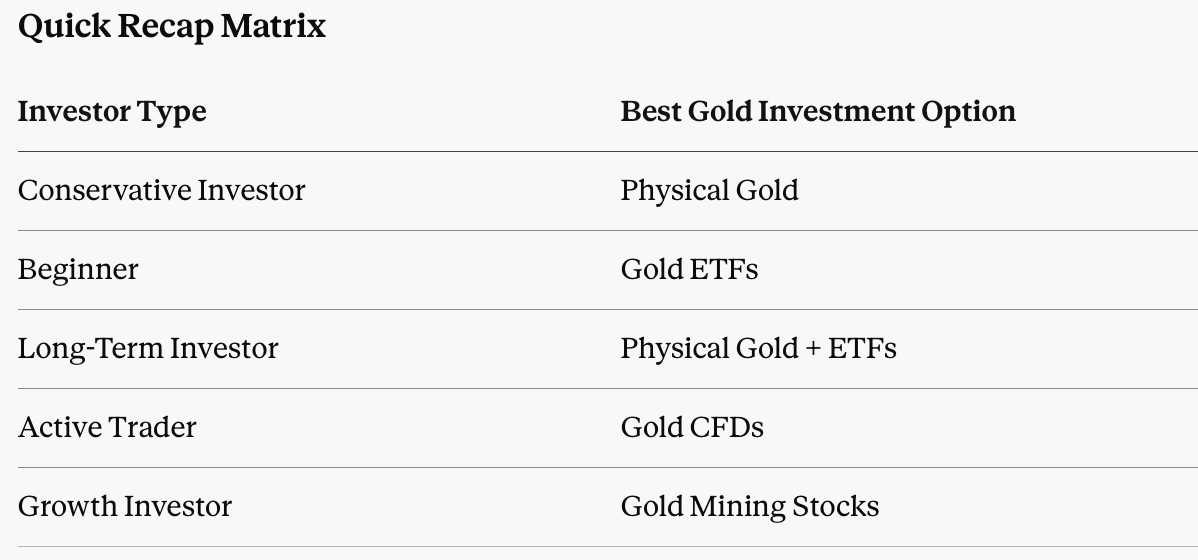
The best gold investment strategy is ultimately the one that aligns with your financial goals, your time horizon, and how much risk you're genuinely comfortable carrying.
Ready to put gold to work in your portfolio? Open a Tradewill account and trade XAU/USD with real-time pricing, transparent spreads, and the risk tools serious gold traders actually use.
Disclaimer: The content of the blog does not represent any position of Trade W, does not serve as any trading-related decision advice, and does not endorse any third-party.