

 Trade W
Crude oil is traditionally the central theme in nearly all traders’ macroeconomic discussions, whether they are focused on inflation data, currency fluctuations, or trends in major equity market indices. Crude oil price movements, particularly large fluctuations, generally transmit their effects quickly across other areas of the economy. Airlines adjust their fuel cost projections, central banks revise their inflation expectations, and commodity-linked currencies often react sharply to related headlines. That's exactly why traders who study cyclical assets and how to spot economic trends before the market moves tend to watch crude oil first, since it often leads rather than follows the broader macro story.
Brent and West Texas Intermediate (WTI) are the two benchmark crude oils that dominate discussions about global oil pricing. By comparing these benchmarks, traders can gain a better understanding of how they differ and how those differences affect supply chains and global politics, while also learning how derivatives, such as forex derivatives like futures, options, and CFDs, are priced and traded.
There are multiple reasons to monitor oil closely, one of the most important being its effect on inflation. Rising crude oil prices increase transportation and manufacturing costs, which are eventually reflected in consumer price data and can influence the policy decisions of central banks. Equity markets may also react to significant movements in oil prices, as energy-related companies often represent a meaningful component of major stock market indices. Since most retail traders do not have access to physical oil markets, CFD trading on Brent and WTI provides a practical way to participate in oil price movements without taking physical delivery of a barrel of oil. This guide will walk you through the key differences between WTI and Brent, how each benchmark is priced, and which may be better suited to your trading style as we move into 2026.
What Is a Crude Oil Benchmark?
A crude oil benchmark is the market's method of assigning a reference value to oil contracts. However, significant variability exists among physical crude oils, as factors such as quality, location, and transportation costs differ from one oil field to another. This creates challenges when determining oil prices across global markets. For example, the cost of transporting a barrel of crude oil from the Permian Basin to a refinery in Rotterdam differs from the cost of transporting a barrel of North Sea crude to the same refinery. As a result, there is no single global price for crude oil. To address this issue, the market uses benchmark prices that provide traders, refiners, and producers with reference points for pricing and hedging purposes.
Futures contracts are the primary instruments used to facilitate oil trading. WTI futures are traded on the Chicago Mercantile Exchange (CME), while Brent futures are traded on the Intercontinental Exchange (ICE). The contract structures used by these exchanges reflect the characteristics of the physical markets they serve. The CME's WTI contract is linked to physical delivery in Cushing, Oklahoma, a major storage and pipeline distribution hub in the United States. In contrast, the ICE's Brent contract is based on North Sea crude oil cargoes delivered through established export infrastructure.
This is one of the primary reasons why WTI and Brent do not trade at identical prices, even though the two crude oil grades are chemically similar. Once it is understood that crude oil prices are based on regional benchmarks rather than a single global price, the differences between WTI and Brent become much easier to understand.
What Is WTI Oil?
WTI, short for West Texas Intermediate, is a crude oil benchmark primarily sourced from Texas, New Mexico, and the broader Permian Basin. WTI is classified as a light, sweet crude oil due to its relatively low density and low sulfur content, characteristics that make it easier and less costly to refine into gasoline and other high-value petroleum products. As a result, WTI has long served as the primary oil benchmark in the United States.
The physical delivery point for WTI futures is located in Cushing, Oklahoma, a major storage and pipeline hub in the United States. This central location connects numerous pipeline networks and differs from benchmarks that rely more heavily on seaborne transportation routes. However, WTI prices can still be highly sensitive to regional supply conditions. For example, when U.S. shale production increases significantly, crude oil inventories can accumulate more quickly than existing transportation and storage infrastructure can accommodate, placing downward pressure on WTI prices. Because shale production now represents a substantial share of total U.S. crude oil output, WTI prices remain closely linked to domestic drilling activity and weekly rig count data.
WTI traders also closely monitor the weekly inventory reports published by the U.S. Energy Information Administration (EIA), as crude oil prices often react to changes in inventory levels. Due to its strong connection to U.S. supply and demand dynamics, WTI frequently responds more quickly and sharply to U.S.-focused economic and energy-related developments than Brent crude. For traders building day trading strategies for 2026, that quick responsiveness is often exactly what makes WTI attractive for short-term setups.
What Is Brent Oil?
Named after the North Sea oil field from which it was originally produced, Brent crude is now a blend of crude oils sourced from several North Sea oil fields. Unlike WTI, which is primarily transported through pipeline networks, Brent is largely transported by tanker, making it an internationally traded commodity as soon as it leaves the production platform.
This seaborne characteristic is one of the main reasons Brent serves as the global benchmark for traded crude oil. A large proportion of crude oil contracts traded worldwide are priced against Brent rather than WTI, including those covering Europe, much of Asia, and large parts of Africa. Because Brent can be loaded onto tankers and redirected to different regions as global supply and demand conditions change, its price tends to reflect international market dynamics more closely than the conditions of any single region.
Brent futures are traded on the Intercontinental Exchange (ICE), and the benchmark is particularly sensitive to geopolitical developments because major global oil supply routes pass through politically sensitive regions and critical shipping chokepoints such as the Strait of Hormuz. When supply disruptions occur in these areas, Brent prices often react first, with WTI prices typically responding shortly afterwards.
Traders interested in how central banks shape forex and broader trading strategy tend to track Brent alongside major currency pairs for this exact reason, since oil shocks frequently force central banks into reactive policy decisions.
WTI Oil vs Brent Oil: The Key Differences Every Trader Must Understand
The primary benefit of comparing WTI and Brent is understanding how their structural characteristics translate into distinct trading markets. The most obvious difference is geographical. WTI is an inland, U.S.-focused benchmark tied closely to pipeline infrastructure, whereas Brent is a seaborne benchmark linked to international shipping routes and global trade flows. This distinction is one of the most important structural differences between the two benchmarks.
Another key difference lies in their respective supply structures. WTI is influenced primarily by U.S. shale production, which has historically been able to respond relatively quickly to changes in demand, creating a more elastic supply profile. In contrast, Brent reflects a broader global supply mix and is influenced by factors such as OPEC+ production decisions, the maturity of North Sea oil fields, and international shipping logistics.
A further distinction involves transportation and distribution costs. Moving WTI from production regions such as the Permian Basin, or from storage facilities in Cushing, Oklahoma, to coastal export terminals requires additional transportation infrastructure. These logistical considerations can influence the pricing relationship between WTI and Brent. By comparison, Brent is produced within a seaborne supply system and is already integrated into major international shipping routes.
The following table compares WTI and Brent:
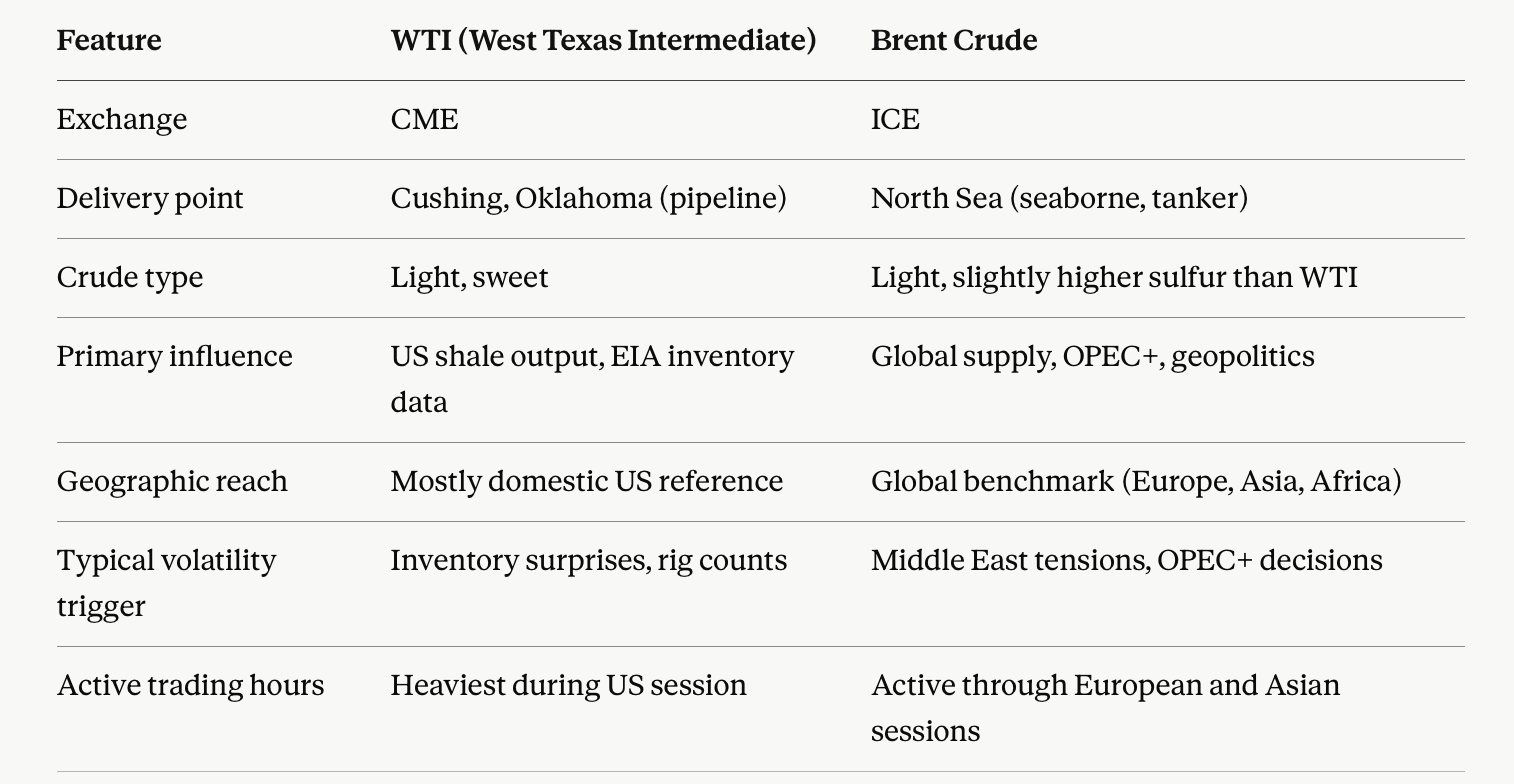
One area that is often missed when looking at the relationships between these two benchmarks (WTI and Brent) is the price difference or spread. The price difference between WTI and Brent has the ability to widen and narrow depending on a number of factors, including US crude oil export capabilities, shipping costs, and changes in the regional supply. Some traders will create an entire trading strategy around this spread through arbitrage techniques that turn price differences into profit. Whether you trade outright futures contracts or CFDs that mirror the price of futures without physical delivery of crude oil, the way these trades are executed may differ slightly; however, the factors that drive both WTI and Brent prices will always be the same.
WTI vs Brent: Which Oil Is Better for Trading in 2026?
When choosing between WTI and Brent for your trading strategy, the decision is often more dependent on your trading style than on which benchmark is objectively better. Scalpers and short-term traders tend to gravitate toward WTI because they can take advantage of the quick and often substantial intraday price movements that occur in response to U.S. inventory data and other domestic market developments. As a result, these traders frequently employ fast entry-and-exit strategies when trading WTI.
In contrast, swing traders who use price action-focused approaches often prefer Brent because its price is typically influenced by broader macroeconomic and geopolitical developments that can unfold over several days. This can make Brent more suitable for traders seeking to capture longer-term market trends rather than short-term price fluctuations.
Average Intraday Volatility

Volatility is not the only consideration when executing a trade; liquidity and execution quality are equally important. Both benchmarks generally provide sufficient market depth to accommodate retail-sized positions. However, during periods of lower trading activity, spreads tend to widen. Traders can help manage this cost by timing their market entries to coincide with more active trading sessions, particularly during periods when major market sessions overlap or when a new session is opening. To keep commissions and fees from eating into trading profits, traders should carefully consider the timing of their trading activity.
What Drives Oil Prices? Macro, OPEC, and Geopolitical Forces Explained
The oil market is a highly complex marketplace, with numerous factors influencing crude oil prices. Many of these forces operate in layers, with each layer affecting how supply and demand are balanced at any given time.
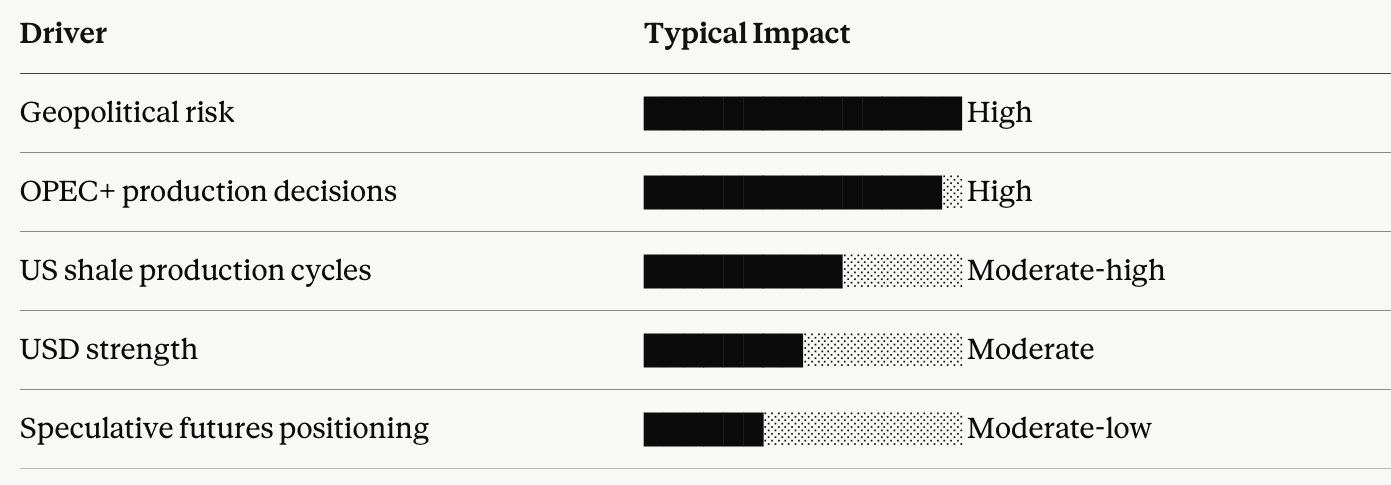
OPEC+ decisions can have a significant impact on crude oil prices because the organisation controls a substantial share of global oil production. For example, an adjustment in production of one to two million barrels per day may appear modest relative to total global output, yet it can still have a meaningful effect on market prices. Weekly inventory data published by the EIA (Energy Information Administration) and the API (American Petroleum Institute) also provide traders with valuable insight into supply conditions, helping them determine whether inventories are increasing or decreasing from week to week. Finally, the strength or weakness of the U.S. dollar is an important consideration because crude oil is predominantly priced in U.S. dollars worldwide. As a result, when the U.S. dollar strengthens against another currency, oil becomes more expensive for buyers using that currency, and vice versa.
Traders following FOMC meeting minutes for interest rate signals often track dollar strength alongside oil prices for this reason, and the connection becomes clearer once you factor in how quantitative easing reshapes currency strength during periods of central bank balance sheet expansion.
Here's a simplified view of how these forces flow into the price you actually trade.
Supply (OPEC+, shale output, inventories) + Demand (global growth, seasonal usage) + Geopolitical risk + USD strength + Speculative positioning → Benchmark price (WTI/Brent) → Retail CFD pricing
How to Trade Oil (WTI & Brent CFD Trading Guide for Beginners)
The entry to the crude oil CFD market for most retail traders is through CFD trading, which removes the need for managing futures contracts and the logistics (physical delivery) of dealing with barrels of crude oil that they will not receive. A CFD (contract for difference) allows traders to speculate on the movement of prices without actually owning the futures contract.
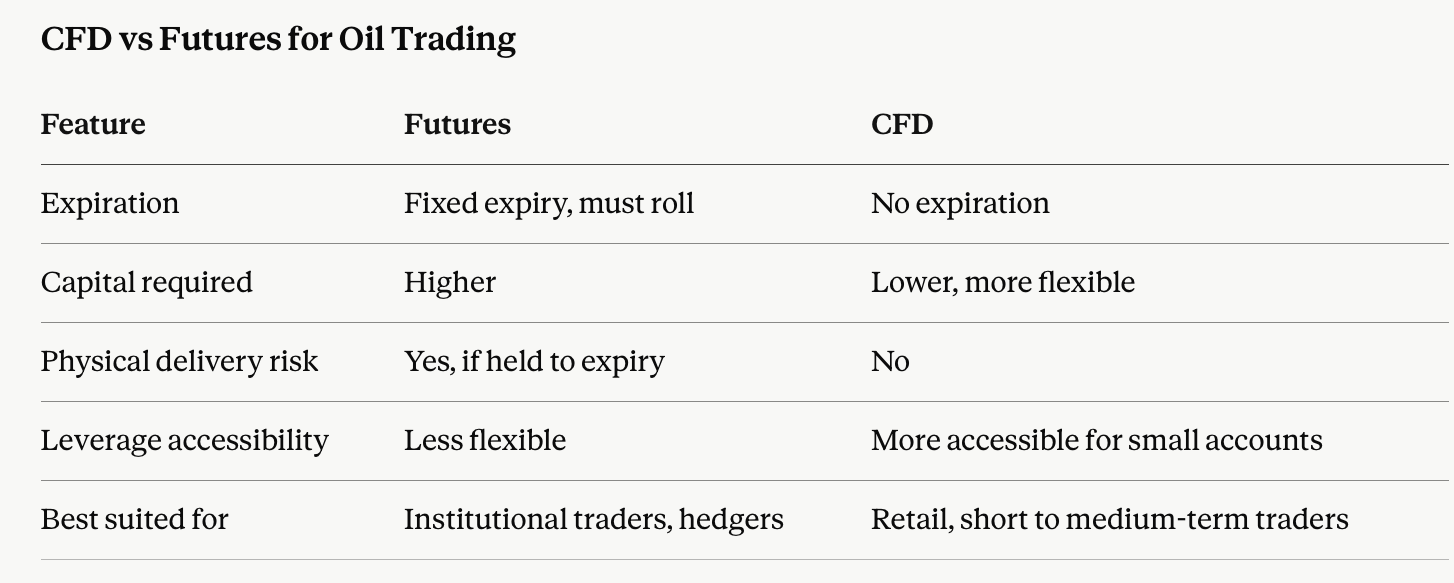
Most people who want to start trading oil CFDs typically do so in a clear order of operations:
- Open a trading account → Select one of the two types of crude oil CFDs (WTI or Brent) – Examine the market/what factors will affect the market → Enter a trade → Monitor position and manage risk.
Oil CFD traders use two types of trading strategies. One type is breakout trading after scheduled inventory reports; this strategy allows traders to capitalise on large price fluctuations that happen after an unexpected number is released by the EIA or API. The other strategy is to trade around scheduled OPEC + meetings and other geopolitical factors that are likely to create volatility in the oil market. Both approaches benefit from studying proven options and volatility strategies before applying similar discipline to crude oil.
Oil Trading Risks: Why Crude Oil Is One of the Most Volatile Markets
Crude oil is typically one of the most volatile assets available to retail traders, meaning that price movements can be both large and sudden. However, this volatility can work to your advantage or disadvantage depending on how effectively it is managed.
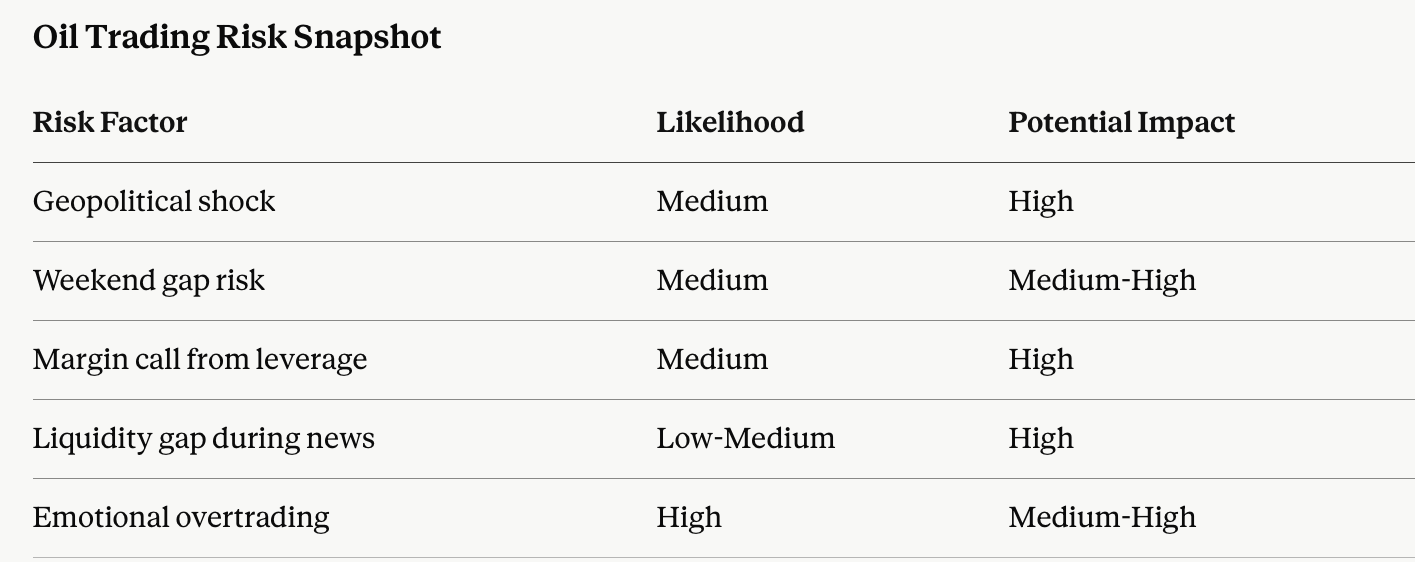
In CFD trading, the use of leverage amplifies volatility because relatively small price movements can generate significant gains or losses in relation to your account size when trading on margin. Therefore, understanding why initial margin matters before it's too late, which occurs when a broker closes positions because there are insufficient funds available to meet margin obligations after a trade has been opened.
Weekend gap risk is another important consideration. Crude oil markets are often affected by major geopolitical, economic, or supply-related developments that can occur while most retail trading platforms are closed. As a result, prices may open significantly higher or lower than their previous closing levels. Developing a structured approach to identifying potential black swan events and protecting your positions before disaster strikes occur is just as important for crude oil trading as it is for forex trading.
Final Thoughts: WTI vs Brent Oil: Which Should You Trade in 2026?
Brent and WTI are two different crude oil benchmarks that represent the global oil market. Each benchmark has its own geographic characteristics and supply-side fundamentals. WTI is often preferred by traders who focus on U.S. market developments and shorter-term trading opportunities, while Brent is commonly used for longer-term trades that are based on broader global supply and demand dynamics.
Both WTI and Brent can be traded successfully, and the benchmark that is best suited to you will depend on your trading strategy, session availability, and tolerance for volatility. Take the time to analyse each benchmark's historical behaviour across a range of market conditions, test your trading strategies using small position sizes if you are new to commodity trading, and develop a comprehensive risk management plan before increasing your exposure to either WTI or Brent CFDs. Opportunities exist in oil trading, but disciplined preparation and risk management are generally more effective than impulsive decision-making.
Trade WTI and Brent the moment the spread moves in your favour, not minutes after. Open a Tradewill account and get live crude pricing, tighter execution, and the tools to act on inventory reports and OPEC+ headlines before the rest of the market catches up.
Disclaimer: The content of the blog does not represent any position of Trade W, does not serve as any trading-related decision advice, and does not endorse any third-party.